

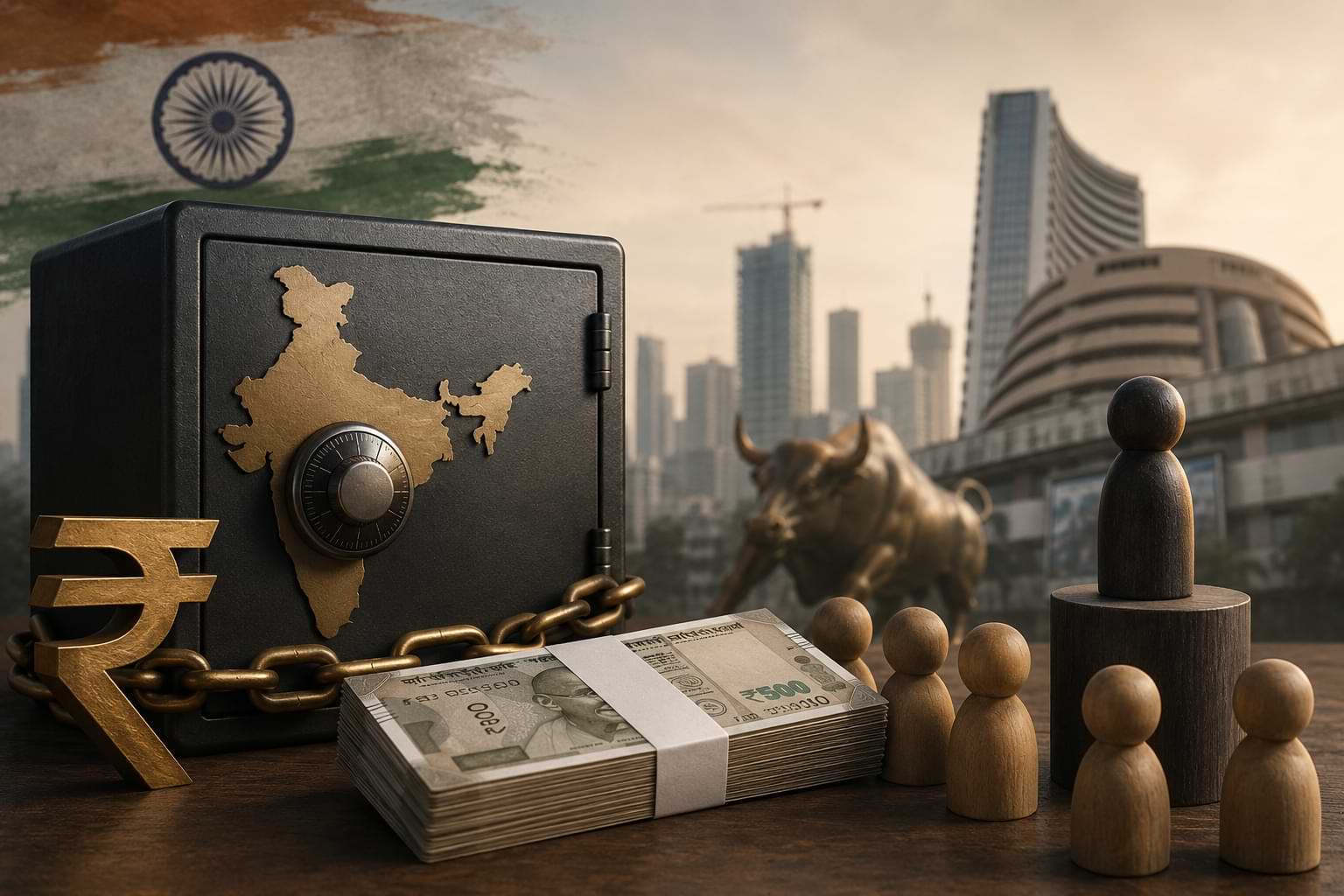
For decades, the Indian stock market felt like a theater with two distinct stages. Out front, in the brilliant glare of the public exchanges (the NSE and BSE), retail investors traded shares of household names with a few clicks of a button. But backstage, in the dimly lit, highly exclusive world of unlisted shares, institutional giants, venture capitalists, and ultra-high-net-worth individuals (UHNWIs) were quietly buying into India’s fastest-growing startups, technology disrupters, and unlisted subsidiaries long before they ever rang an IPO bell.
For a long time, the barrier to entry for this backstage pass wasn’t just knowledge—it was an astronomical amount of capital. If you wanted a piece of a pre-IPO company, you often needed relationships, access to institutional brokers, and tens of millions of rupees.
Then came a structural shift. Digital marketplaces emerged, democratizing access and allowing fractional ownership. Suddenly, everyday investors could buy a piece of the next big tech unicorn or a regional manufacturing powerhouse. But as retail enthusiasm surged, regulatory caution and platform standardization stepped in to draw a new boundary line.
Today, if you look to cross over into the private equity sandbox, you will encounter a firm, widely accepted standard: the ₹2 Lakh minimum investment threshold per company.
This isn’t an arbitrary number plucked out of thin air. It is a calculated boundary designed to balance accessibility with financial survival. Let’s dive deep into why this threshold exists, what it means for your portfolio math, and how to navigate the high-stakes world of unlisted equities.
The Anatomy of the Threshold: Why ₹2 Lakhs?
To understand why platforms require a minimum investment of ₹2,00,000, you have to peel back the operational and psychological layers of the unlisted market. Unlike public equities, where a clearing corporation seamlessly matches millions of buyers and sellers a second, the unlisted ecosystem is built on a framework of private placements, manual demat transfers, and bespoke liquidity matching.
1. The Friction of Administrative Overhead
Every time an unlisted share changes hands, it isn’t just a blip on a computer screen. The transaction requires a sequence of compliance steps. Shares must be debited from a seller’s specialized demat account, matched against a specific contract note, and credited to the buyer’s demat account via National Securities Depository Limited (NSDL) or Central Depository Services Limited (CDSL).
Because these companies are not yet listed on public bourses, the processing times, stamp duties, and administrative overhead per transaction are significantly higher. If platforms permitted retail investors to buy ₹5,000 or ₹10,000 worth of shares, the operational costs would rapidly swallow the margins, making the entire ecosystem unsustainable.
2. A Psychological Self-Filter for Risk
The private market is a completely different beast compared to the public market. There is no daily circuit limit, no instant liquidity, and very little hand-holding. By standardizing the minimum ticket size at ₹2 Lakhs, institutional market makers establish a natural psychological filter.
An investor who can comfortably allocate ₹2 Lakhs to a single unlisted asset is statistically more likely to possess the financial literacy, capital cushion, and long-term horizon required to survive the volatility of the private markets. It forces you to look at the investment not as a casual trade, but as a deliberate, calculated corporate allocation.
Evaluating the Risks: What They Don’t Tell You on Social Media
The allure of unlisted shares is undeniable. Stories of early investors in tech giants multiplying their wealth by $50\times$ or $100\times$ post-IPO flood financial news feeds. However, the private market operates under a strict rule of asymmetry: with outsized potential returns comes an equally massive matrix of risks.
Unlisted Investment Risk Matrix
The Liquidity Desert
When you buy a public stock, you can change your mind five minutes later, hit “Sell,” and watch the cash settle into your account. In the unlisted market, there is no public trading floor. If you experience a sudden personal financial crisis and need to liquidate your ₹2 Lakh investment, you cannot simply cash out. You are entirely dependent on find a buyer through a private desk, which can take days, weeks, or even months, often forcing you to accept a steep haircut on your principal.
The Information Black Hole
Publicly traded companies are legally bound by SEBI to disclose detailed financial results every single quarter, alongside immediate material updates. Unlisted companies are under no such obligation. They operate under MCA (Ministry of Corporate Affairs) guidelines, meaning you might only get a clear look at their financial health once a year when they file their audited annual reports. Investing ₹2 Lakhs into a company where you cannot track real-time operational pivots requires a profound level of trust and independent due diligence.
The Regulatory Post-IPO Lock-In
A common misconception among retail investors is that they can flip their unlisted shares the exact morning the company lists on the stock exchange. According to current SEBI regulations, shares held by investors in a company prior to its Initial Public Offering (IPO) are subject to a mandatory 6-month lock-in period from the date of allotment in the IPO. If the market experiences a wild post-listing correction during those six months, you can only sit and watch from the sidelines until your lock-in expires.
Portfolio Math: Where Does This Fit?
Because of the ₹2 Lakh minimum, asset allocation math becomes incredibly strict. A foundational rule of prudent wealth management dictates that high-risk, highly illiquid alternative assets should never comprise more than $5\%$ to $10\%$ of an individual’s total investment portfolio.
If the minimum entry point per company is ₹2 Lakhs, let’s look at how that scales:
- To buy into just one unlisted company safely, your overall investable surplus (across mutual funds, fixed income, and public equities) should ideally be at least ₹20 Lakhs to ₹40 Lakhs.
- If you want to properly diversify across three distinct unlisted sectors (e.g., one fintech, one deep-tech, and one green energy firm) to avoid single-company failure risk, you are looking at a total unlisted outlay of ₹6 Lakhs. This implies your broader portfolio should scale closer to ₹60 Lakhs to ₹1.2 Crores.
If allocating ₹2 Lakhs to a single asset represents $30\%$ or $50\%$ of your net worth, you are over-indexing into a highly speculative asset class—a move that could jeopardize your foundational financial security. To run comprehensive scenario analyses and discover how to balance private equity with liquid instruments without destabilizing your financial plan, check out the portfolio simulators hosted at the Rits Capital Wealth Engine.
Due Diligence: The Checklist for Your 2 Lakhs
If you have the financial runway and the risk tolerance to step through the ₹2 Lakh doorway, you must approach your research with professional rigor. Before transferring a single rupee to an unlisted platform, run through this non-negotiable due diligence checklist:
- Verify Demat Crediting Timelines: Ensure the platform you are using guarantees delivery of the shares directly to your NSDL or CDSL demat account within a standard $T+1$ or $T+2$ window. Never leave your shares in a pooled or custodial account managed by a third party.
- Analyze Capital Structure & Dilution: Review the company’s recent funding rounds. Are founders actively diluting their stakes? Are early venture capital funds looking to dump their shares onto retail buyers via the unlisted market as an exit strategy?
- Cross-Reference Valuation Metrics: Platforms price unlisted shares based on localized supply and demand. Cross-examine the Price-to-Earnings ($P/E$) or Price-to-Sales ($P/S$) multiples of the unlisted company against its closest publicly traded peers. If the unlisted company is trading at a premium to an established public market leader, you are likely overpaying for hype.
For access to institutional-grade research papers, direct cap-table breakdowns, and vetted pre-IPO opportunities structured for long-term compounding, consult the Rits Capital Unlisted Equity Desk.
Frequently Asked Questions (FAQs)
Q1: Is the ₹2 Lakh minimum investment in unlisted shares a legal mandate by SEBI?
No, SEBI does not currently mandate a strict legal minimum for retail purchases of unlisted shares via secondary transfers. The ₹2 Lakh threshold is an operational and risk-management standard adopted voluntarily by premier unlisted investment platforms to offset high administrative costs and filter for qualified, long-term investors.
Q2: Can two or more friends pool ₹50,000 each to meet the ₹2 Lakh minimum?
While technically possible via joint demat accounts or private trust structures, pooling capital with friends to purchase unlisted shares is highly discouraged. Demat shares must ultimately be registered to specific legal identities, and fractional ownership outside an institutional framework can lead to complex legal disputes, taxation headaches, and massive exit hurdles.
Q3: What happens to my ₹2 Lakh investment if the company cancels its IPO plans?
If a company shelves its IPO plans, your shares remain active in your demat account as unlisted equity. You continue to hold a proportional ownership stake in the private company, but your capital remains highly illiquid. Your only exit option would be to sell those shares back into the secondary unlisted market through a platform, subject to prevailing market demand and potential valuation hits.
Q4: How are capital gains taxed on unlisted shares in India?
Unlisted shares face a different tax structure compared to listed equities. If held for less than 24 months, gains are classified as Short-Term Capital Gains (STCG) and are added directly to your income, taxed at your applicable slab rate. If held for more than 24 months, they qualify as Long-Term Capital Gains (LTCG) and are taxed at a flat rate of $20\%$ with indexation benefits (or $12.5\%$ without indexation, depending on the latest financial year amendments).
Q5: Can unlisted shares be transferred directly to my standard Zerodha, Groww, or Angel One demat account?
Yes. Unlisted shares are electronic securities. As long as you provide the correct Client ID, DP ID, and regular NSDL/CDSL target details to the executing desk, the unlisted shares will land securely in your standard demat account alongside your public stocks, though they will usually display without a live ticker price until listing occurs.