

For years, the narrative surrounding global equity growth was dominated by a single, monolithic theme: Silicon Valley. Investors looking for hyper-scale expansion implicitly accepted that the United States was the default engine for the future.
But a massive, structural tectonic shift has re-aligned global equity markets.
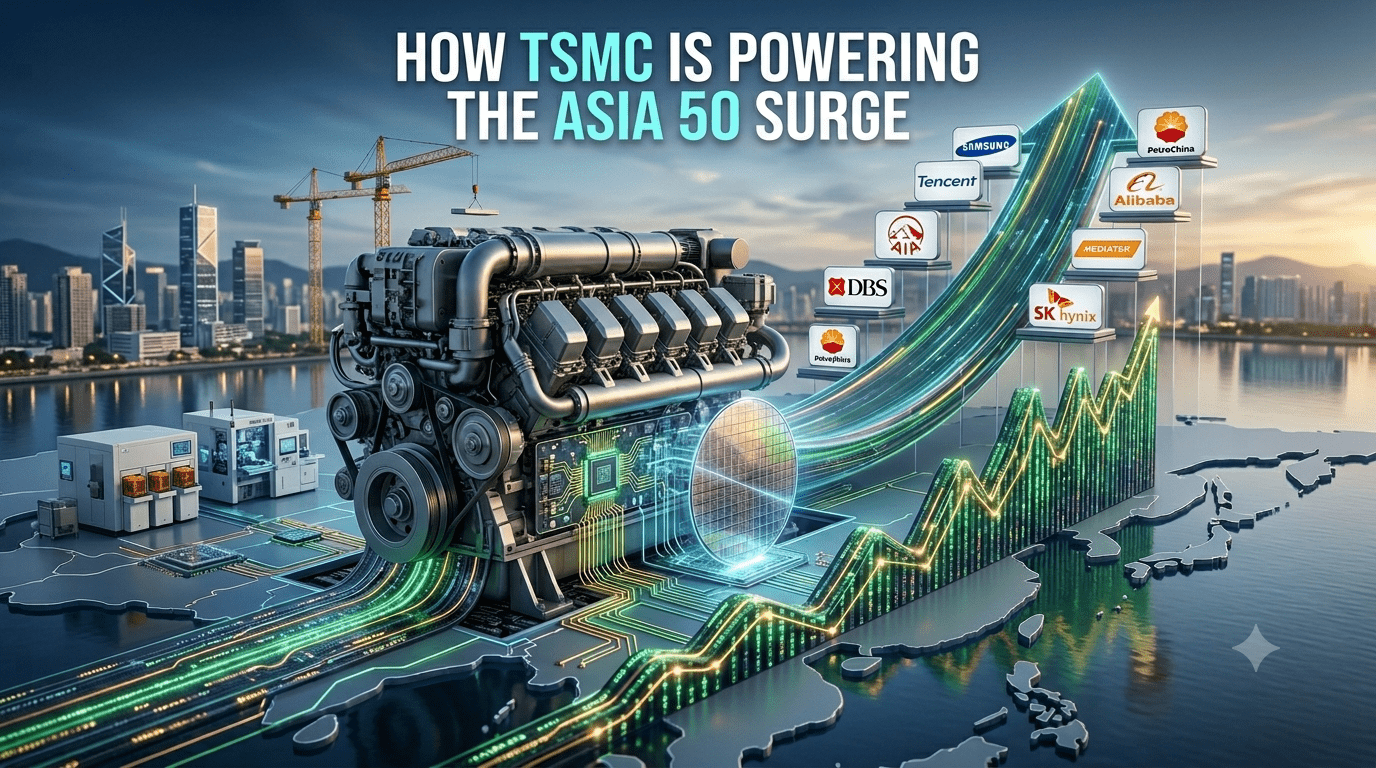
The Taiwanese stock market has officially overtaken India to become the world’s fifth-largest equity market by total market capitalization, with South Korea following in rapid succession. This sudden, multi-trillion-dollar realignment in regional dominance has transformed broad indices like the Asia 50.
And at the dead center of this explosive growth sits a single company: Taiwan Semiconductor Manufacturing Company (TSMC).
For everyday wealth builders and private investors, understanding the gravity of TSMC’s outsized market influence is no longer optional. It is the defining feature of the modern, hardware-driven macroeconomic cycle. Let’s pull back the curtain on how this chip-making colossus is rewriting the investor playbook across the Eastern hemisphere.
Understanding the “Monoculture” of the Asia 50 Surge
To comprehend why the Asia 50—an index tracking the 50 largest, most liquid blue-chip companies across moving Asian economies—is surging, you have to look at its underlying concentration.
Historically, diversified indices balanced financial institutions, energy networks, consumer staples, and conglomerates. However, the artificial intelligence paradigm has completely broken traditional weighting architectures.
The Concentration Reality: TSMC now commands over 42% of the benchmark index weight on its domestic exchange. When global funds buy broad exposure to high-growth Asian equities, they are fundamentally buying a direct equity stake in the world’s premier silicon foundry.
This deep concentration has fundamentally detached tech-heavy regional indices from broader local economic realities. For example, while India boasts a massive, fundamentally diverse $4.15 trillion domestic economy, its equity markets are heavily weighted toward domestic banking and financial sectors.
In sharp contrast, Taiwan and South Korea operate as the industrial fabric of global tech hardware. Because advanced chip manufacturing is sitting at the precise apex of the current investment cycle, capital is concentrating heavily where physical infrastructure actually meets AI execution.
The Cold Hard Fundamentals: Beyond the AI Hype
When asset valuations run as hot as the technology sector has over the last 18 months, an experienced investor’s first instinct is to scan for a bubble. Healthy skepticism is a vital tool for capital preservation.
However, looking under the hood of TSMC reveals a major operational truth: this surge isn’t built on speculative promises or vaporware. It is backed by historic, verifiable balance sheet growth.
- Accelerating Monthly Performance: TSMC reported its consolidated financial data for May 2026, posting net monthly revenues of NT$416.98 billion (approximately $13.25 billion USD). This represents a direct 1.5% sequential gain from April, but more importantly, a staggering 30.1% year-over-year surge compared to May 2025.
- The Year-to-Date Baseline: For the first five months of 2026, TSMC’s cumulative revenues hit NT$1,961.80 billion (~$62.35 billion USD), tracking exactly 30.0% higher than the parallel period from the prior fiscal year.
This breakneck growth is driven by structural, inelastic global demand. TSMC controls roughly 72% of the world’s advanced node semiconductors. Whether an AI application is designed by NVIDIA, AMD, Apple, or Google, the physical chips must travel through TSMC’s fabrication facilities in Hsinchu and Tainan. They do not just participate in the tech economy—they own the toll roads.
Market Playbook: Navigating Tech Volatility in Asia
The sheer scale of this concentration introduces unique risk-reward dynamics that require sophisticated management. As an investor looking to capture this hardware-driven boom, consider these three tactical baselines:
1. Anticipating the Macro Breathing Room
When an individual stock dictates the direction of an entire regional index, broad market macro-pulses can cause severe localized corrections. For example, slight reassessments in Western tech valuations can trigger immediate, outsized automated sell-offs across Asian tech indices, regardless of underlying company earnings.
- Investor Strategy: Do not panic-sell during localized structural drawdowns. Treat tech-centric index pullbacks as organic liquidity events to accumulate high-conviction positions at a fundamental discount.
2. Regulatory Tailwinds & Inflow Channels
Capital movement is increasingly cleared by regulatory updates. Taiwan’s financial regulators actively expanded domestic fund allocation parameters, allowing local asset managers to hold up to 25% of their net assets in individual companies whose index weighting exceeds 10%.
- Investor Strategy: This regulatory adjustment alone is projected to unlock billions of dollars in structural, domestic institutional inflows directly into TSMC, creating an organic domestic floor under the stock’s valuation.
3. Diversifying Beyond the Foundry Floor
While TSMC represents the crown jewel, its blistering growth naturally ripples down an extensive, highly specialized regional supply chain.
- Investor Strategy: To mitigate single-stock concentration risk, look laterally at the critical supply ecosystem. Companies specializing in extreme ultraviolet (EUV) photolithography, specialized chemical etching materials, and advanced packaging networks across Japan, South Korea, and Taiwan offer excellent derivative growth vectors.
Investor FAQ: Decoding the Tech Hardware Landscape
Why is Taiwan’s stock market cap outpacing larger domestic economies like India?
Equity market capitalization is a reflection of corporate valuations and sector concentration, not total national GDP. Taiwan’s equity markets are heavily weighted toward high-value tech hardware and semiconductor manufacturing, which are at the epicenter of the global corporate spending cycle. India’s broader, fast-growing economy reflects a wider mix of financial, service, and consumer sectors that move on different macro cycles.
How vulnerable is TSMC to regional geopolitical risks?
Geopolitical risk is the primary overhang on TSMC’s long-term valuation. To hedge against localized geographic concentration, TSMC is actively deploying tens of billions of dollars to construct advanced fabrication facilities globally, including major multi-phase projects in Arizona, Germany, and Japan. This global footprint diversification is explicitly designed to de-risk the western tech supply chain.
Is the current semiconductor surge sustainable, or are we near a cyclical peak?
While the traditional semiconductor sector has historically been highly cyclical, the structural rollout of global AI data center infrastructure, advanced automated vehicles, and high-performance edge computing acts as a multi-year secular growth driver. Temporary corrections will occur as supply chains normalize, but the fundamental baseline demand for sub-3nm nodes remains historically high.
Protect and Optimize Your Capital with Rits Capital
When an single asset class or corporate giant single-handedly moves an entire region’s financial index, standard, passive “set-and-forget” portfolio strategies introduce invisible risk concentrations. Capturing the historic upside of the Asia 50 surge—while protecting your foundational wealth against sector-specific volatility—requires institutional-grade execution.
At Rits Capital, we work alongside high-net-worth investors and family offices to construct resilient, macro-hedged portfolios. Our global investment teams specialize in navigating cross-border tech exposure, identifying supply-chain alpha, and executing tactical rebalancing strategies that ensure your wealth is positioned precisely where secular growth meets structural safety.
Want to insulate your portfolio from concentration risk while maximizing global tech growth? Connect with a dedicated private wealth manager at Rits Capital today to request your private portfolio audit.